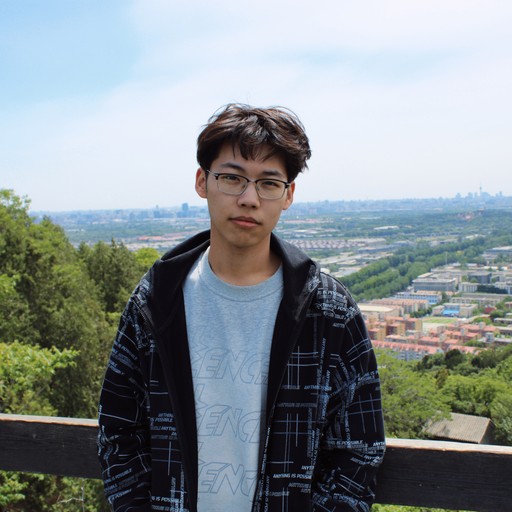
Hi! I am Zeyu Ren (任泽宇), a Master of Engineering (Mechatronics) student at the University of Melbourne, working on generative models, world models, and dense prediction (e.g., depth and surface-normal estimation).
In today’s AI era, I believe writing code is no longer the hardest part of research; the harder and more valuable skill is the ability to spot the right problems, whether they surface from theory, from visualization, or from careful self-reflection. Once a problem is found, what matters is how to solve it — and how to make the solution simpler and explain it more clearly and coherently at a theoretical level. Equally important is presentation: how to convey an idea so that others can truly understand it. These are the abilities I most want to improve during my PhD. Above all I value simplicity, avoiding redundancy and over-design. I also read broadly beyond my own field, since ideas from other areas often spark new ways of thinking about my own problems.
I am currently looking for PhD opportunities (Fall 2027) in related areas — if you think we might be a good fit, please feel free to reach out.
⏳ What Am I Doing Right Now?
- World models that drive rendering engines.
🔥 News
- 2026.11: 🎉 Our paper PINE is out, and we release the code and model.
- 2026.11: 🎉 Our paper PanDWM is out, and we release the code and model.
- 2026.02: 🎉 Our paper StereoAdapter-2 is on arXiv, and we release the code.
- 2026.01: 🎉 Our paper AnyDepth is on arXiv, and we release the code.
📝 Publications
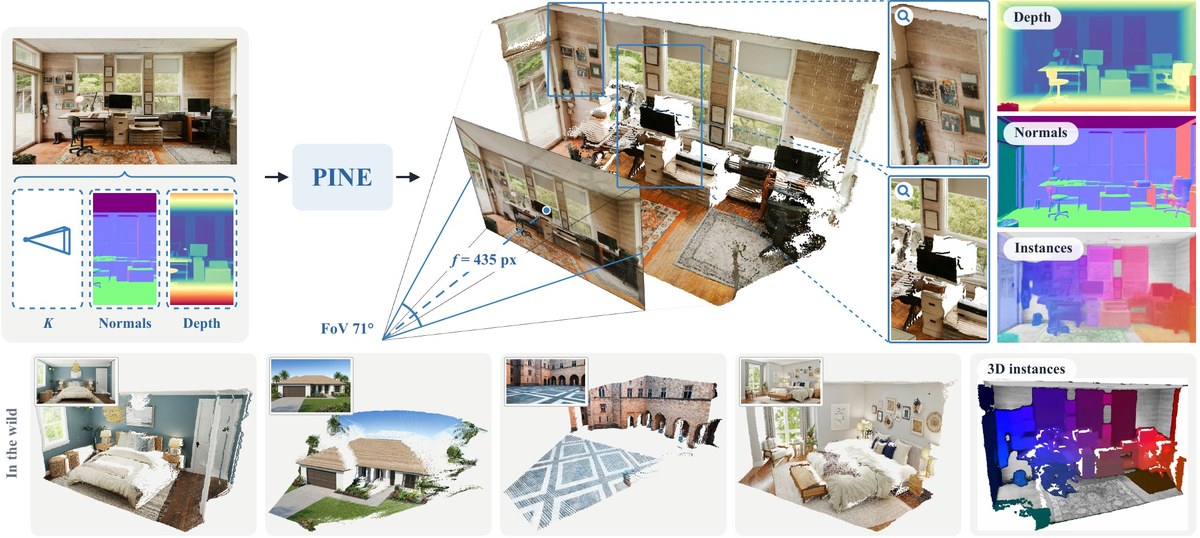
PINE: Point, Instance and Normal Estimation in One-Step Diffusion Model
Zeyu Ren, Jie Ni✉︎, Rui Qian✉︎, Jiahao Wei, Hao Tang, Yongtai Liu, Zeyu Zhang†
✉︎Corresponding authors. †Project lead. The University of Melbourne · Southeast University · Fudan University · Peking University · Hanyang University.

- A one-step omni Diffusion Transformer that predicts the point map, surface normals and instance map of an image in one forward pass; each map is a token stream with its own input and output layers, sharing the transformer blocks under a stream mask.
- A camera-aware ray encoding positions every token by its camera ray, and grounding attention adds the affinity of frozen DINOv3 features to the attention logits.
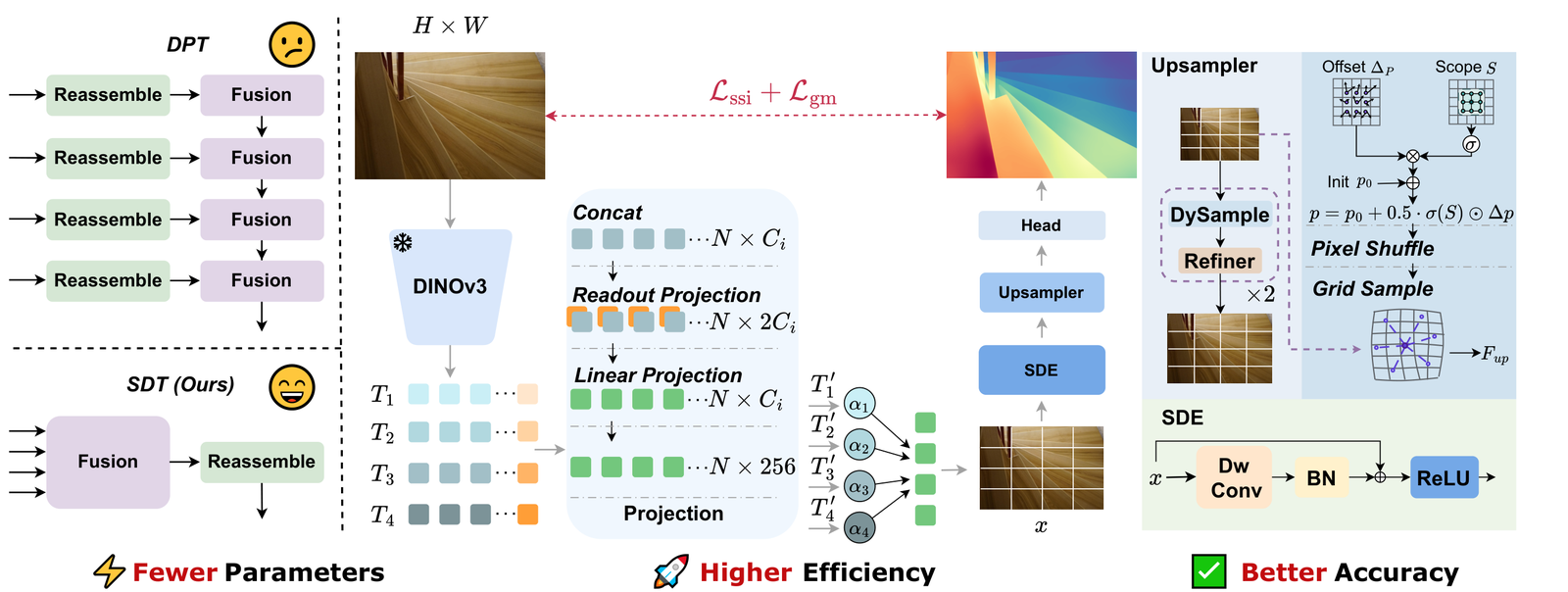
AnyDepth: Depth Estimation Made Easy
Zeyu Ren*, Zeyu Zhang*, Wukai Li, Qingxiang Liu, Hao Tang
*Equal contribution. The University of Melbourne · Peking University · Shanghai University of Engineering Science.

- A frozen DINOv3 encoder paired with the Simple Depth Transformer (SDT), a single-path decoder that cuts decoder parameters by 86.6–89.2% while improving the efficiency–accuracy trade-off over DPT heads.
- Two depth-specific quality scores (distribution, gradient continuity) filter training data from 584K to 369K samples while preserving accuracy.
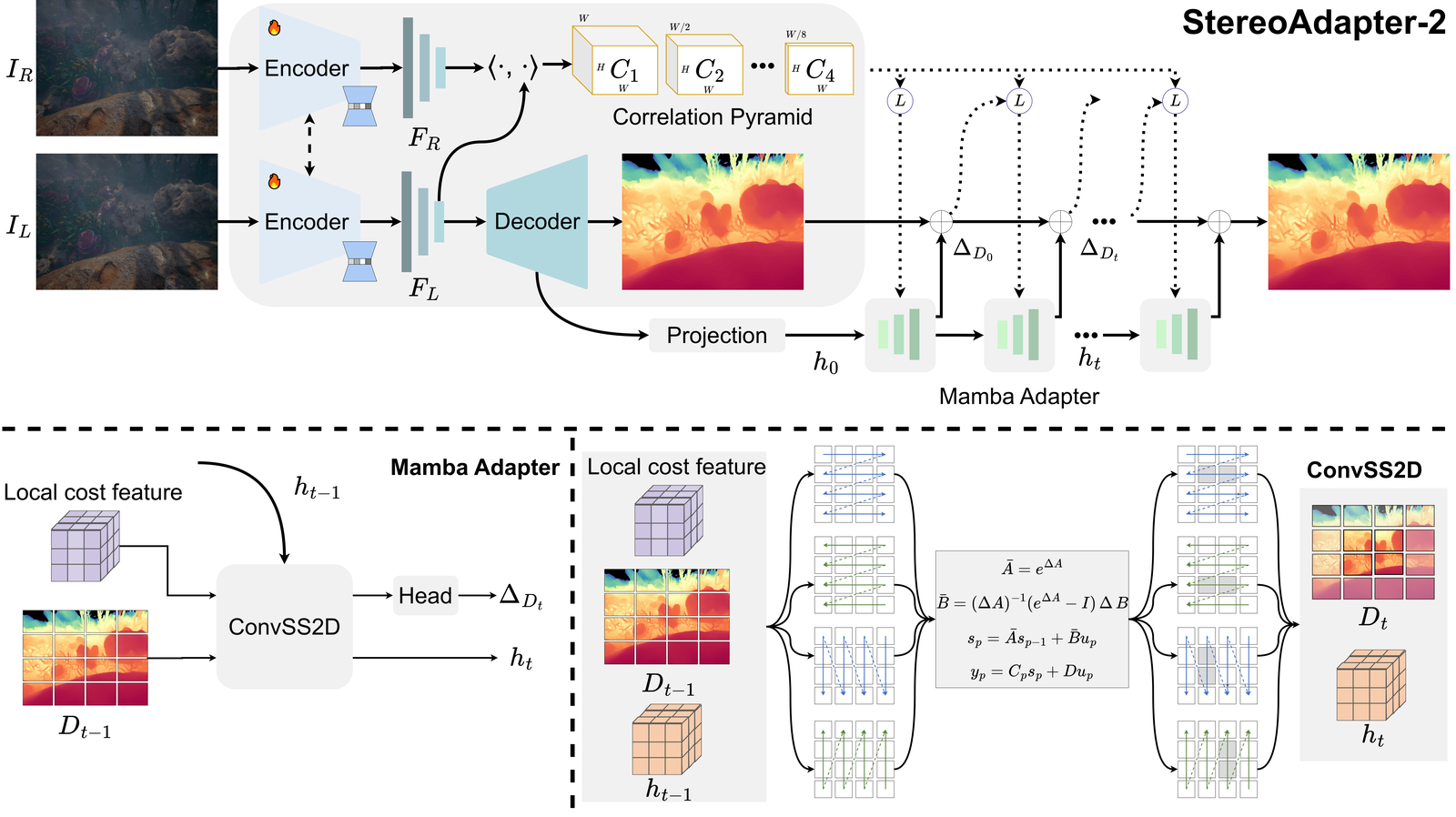
StereoAdapter-2: Globally Structure-Consistent Underwater Stereo Depth Estimation
Zeyu Ren*, Xiang Li*, Yiran Wang*, Zeyu Zhang*, Hao Tang
*Equal contribution. The University of Melbourne · Peking University · Australian Centre for Robotics.
- An underwater stereo framework centered on ConvSS2D for long-range, content-adaptive disparity refinement, with the synthetic UW-StereoDepth-80K dataset; improves RMSE by 17.0% (TartanAir-UW) and 7.2% (SQUID) over StereoAdapter, validated on a real BlueROV2 platform.
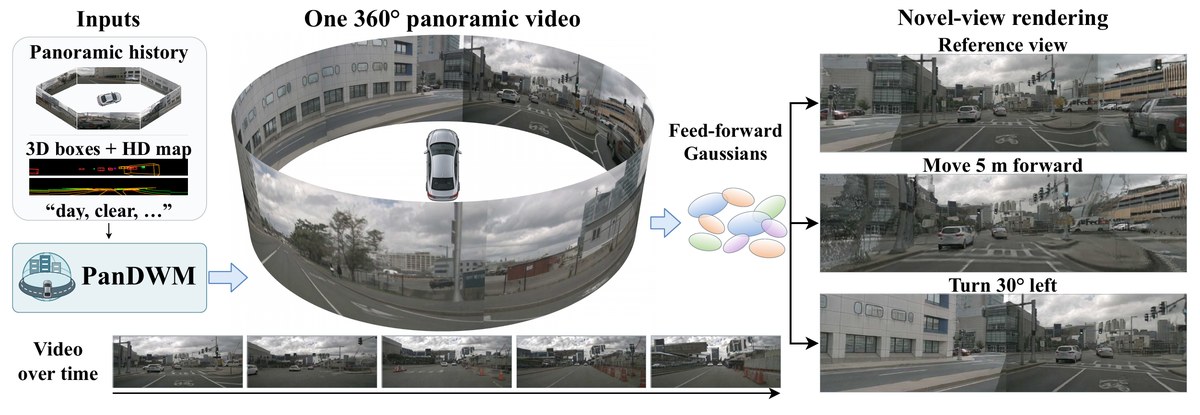
PanDWM: Panoramic 4D Driving World Models
Jiajun Sun*, Zeyu Zhang*†, Zeyu Ren, Guangfeng Jiang, Yang Zhao, Hao Tang‡
*Equal contribution. †Project lead. ‡Corresponding author. Shenzhen University · Peking University · The University of Melbourne · La Trobe University.

- A driving world model that generates one 360° panoramic band instead of six pinhole videos, conditioned on 3D boxes and HD maps, so the model does not have to learn cross-view consistency.
- A four-step causal student matches the FID of its 50-step teacher on nuScenes (10.1 vs. 9.93), lowers FVD-1 from 47.7 to 37.4, and runs at 1.96 s instead of 33.7 s per frame; a feed-forward decoder lifts each frame into 3D/4D Gaussians.
- SA-CMamba: Stripe-aware CNN-Mamba Hybrid Network for Pixel-level Surface Defect Detection, W. Li, C. Wang, W. Feng, X. Wang, Z. Ren, J. Wang, C. Wang, Q. Lu, Measurement 2025 (Elsevier)
🎖 Honors and Awards
- RoboCup, Robot World Cup (China), Member of Visual Group. 2021.01 - 2021.05
- Acquired depth maps with a Kinect-v2 depth camera and set up ROS communication with a robot arm to realize object grasping.
- Won the China National Second Prize, RoboCup Family Division — Open Platform.
- China National College Students Mechanical Innovation Design Competition, Member. 2021.09 - 2022.06
- Designed a robot dog with servo modules concentrated at the thigh root — driven by a parallelogram linkage — to reduce the leg’s moment of inertia and servo load.
- Won the Beijing Municipal Second Prize.
📖 Educations
 2019.09 - 2023.06, B.Eng., Beijing University of Chemical Technology.
 2024.02 - now, Master of Engineering (Mechatronics), University of Melbourne.
💻 Internships
 2025.03 - now, Peking University, Research Assistant. Advisor: Hao Tang.
- Generative models. Rethinking the latent space diffusion models operate in, and how latent quality shapes downstream prediction.
- World models. Looking for a more reasonable way to build feed-forward world models.
- Dense prediction. Efficient zero-shot monocular depth via a single-path decoder (AnyDepth), and globally structure-consistent underwater stereo depth via selective state-space refinement (StereoAdapter-2).
 2024.05 - 2025.03, Northwestern Polytechnical University, Research Assistant.
- Proposed SDDMamba, combining the local feature extraction of CNNs with the efficient global-context modeling of Mamba to enhance hierarchical feature representation.
- Improved and debugged Latent Diffusion model code for joint dual-task prediction of depth and normal maps, providing experience and data on the limitations of diffusion models under multi-task learning.
- Explored mechanisms for leveraging polarization information to improve normal reconstruction, and new ways to combine optical cues with NeRF and 3D Gaussian Splatting for 3D reconstruction and fine surface-feature extraction.
 2024.03 - 2024.05, RMIT University, Research Assistant.
- Studied mainstream visual interpretability methods based on Gradient-weighted Class Activation Mapping (Grad-CAM).
- Used PyTorch to validate the feasibility of a Fisher-information-metric-based algorithm for visual interpretability tasks.
🛠 Academic Services
- Conference Reviewer: ACM MM 2026